Most water heater calls in the Quad-City area come in between November and March, and that is no coincidence. When the supply water arriving at your heater is near freezing, the unit has to work much harder to deliver the same shower. A tank that coasted through summer suddenly runs out halfway through the second shower of the morning, and a heater that was already struggling picks the coldest week of the year to quit.
Water heater repair in Prescott works best when the plumber starts by asking why the unit is struggling, not just which part is broken. Gas, electric, or tankless, the service covers thermostats, heating elements, pilot and gas control problems, anode rods, tank flushing, tankless descaling, and full replacement when that is the right answer. Calls to Prescott Plumbing Pros are answered around the clock in English or Spanish and routed to a local plumber.
Is It Broken, or Is It Just Winter?
Before assuming the worst, it helps to know that a heater losing ground in cold weather is not always failing. Here is how to read what you are seeing.
- Hot water runs out sooner, only in winter. Often normal for a borderline-sized tank. Colder incoming water means each gallon needs more heating, so the usable supply shrinks. Raising the setting slightly or adding a mixing valve can help.
- Hot water runs out sooner all year. Sediment is taking up tank volume, an element has failed on an electric unit, or the dip tube has broken and cold water is mixing at the top.
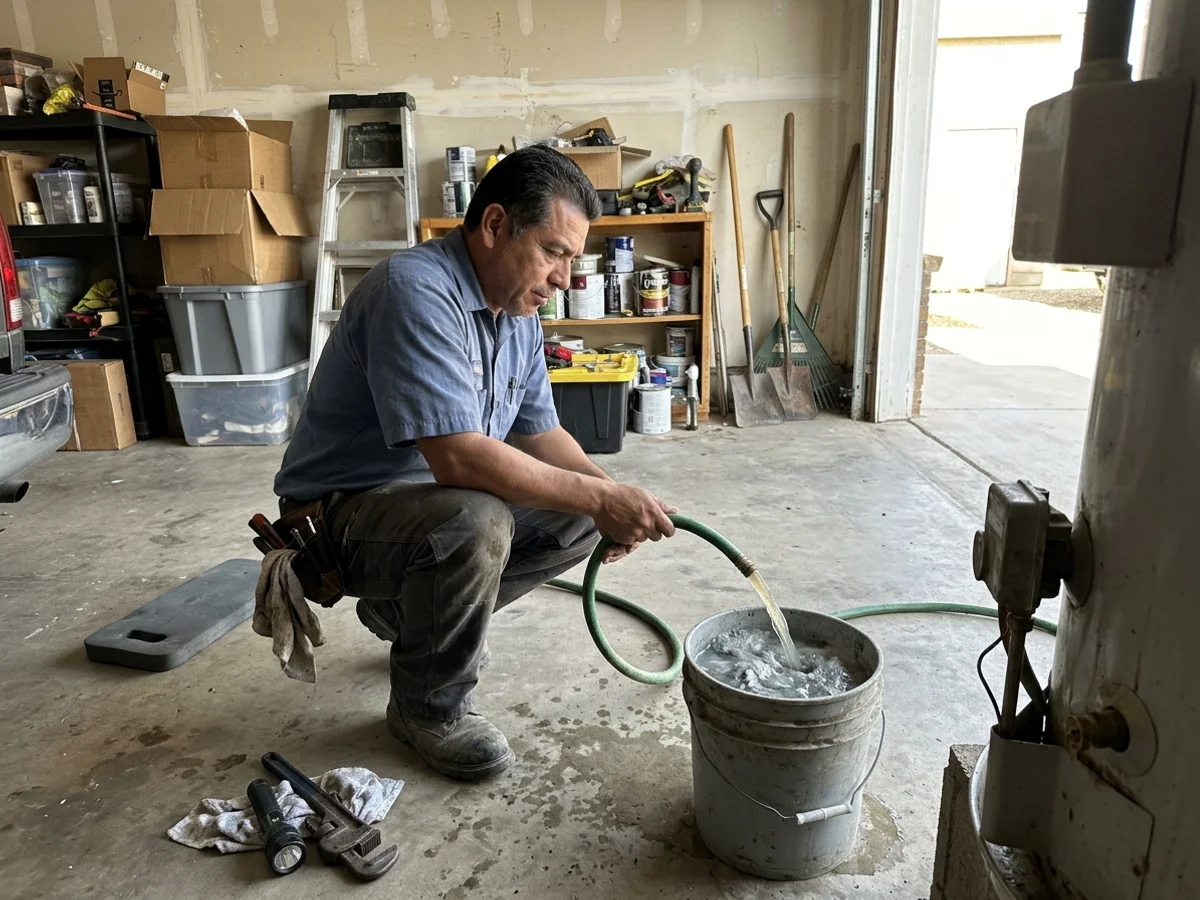
- Popping, crackling, or rumbling. Water trapped under sediment flashes to steam. A flush often helps.
- Rusty water from the hot side only. The anode rod is likely spent and the tank is corroding inside. Treat it as a late warning.
- No hot water at all. On gas units, a pilot, thermocouple, or gas control issue. On electric units, a tripped high-limit switch, a burned element, or a bad thermostat. These are usually repairs.
- Moisture at the base. A loose fitting, a relief valve doing its job, or a tank starting to fail. It needs checking before anyone condemns the heater.
Repair or Replace: How the Recommendation Is Made
| Condition | Usual Recommendation |
|---|---|
| Younger unit, failed element, thermostat, or thermocouple | Repair the part |
| Popping tank with moderate sediment, no leaks | Flush and check the anode |
| Rust in hot water and a spent anode on an older tank | Plan a replacement soon |
| Water seeping from the tank body | Replace |
| Tankless unit throwing scale or flow codes | Descale and set a maintenance schedule |
You should be able to see the evidence: the sediment from a flush, the condition of the anode rod, the corrosion at the fittings. Request a free estimate and ask about any service call fee before booking.
Where Your Heater Sits Matters in a Cold Climate
Many local homes have heaters in garages, utility closets on exterior walls, or basements and crawl space areas that get cold in winter. That location affects both performance and risk.
- Standby losses climb. A tank sitting in a cold garage loses heat to the air around it, so it fires more often.
- Lines can freeze. The cold supply, the hot outlet, and the relief valve discharge pipe can all freeze in an unheated space on the coldest nights.
- Tankless units need protection. Many have built-in freeze protection that depends on power and gas staying on. A power outage during a cold snap can leave them exposed.
In cabins and second homes outside Prescott that sit empty through winter, draining the heater or keeping the space reliably heated is the safest approach.
Sediment, Hardness, and What It Means Here
The City of Prescott describes its water as moderately hard, averaging 4.3 to 7.6 grains per gallon. That means sediment and scale build up in a tank, but slowly. An annual flush handles it for most households. Homes on private wells or other providers in Chino Valley and nearby areas can read differently, so testing at the tap is the only way to know what your heater is dealing with.
Tankless units are more sensitive, because water passes through narrow heat exchanger passages at high temperature. On city water, descaling about once a year is a reasonable starting point. A softener is optional and can stretch that interval, but it is a comfort and appliance-life choice rather than a requirement here.
What a Proper Replacement Includes
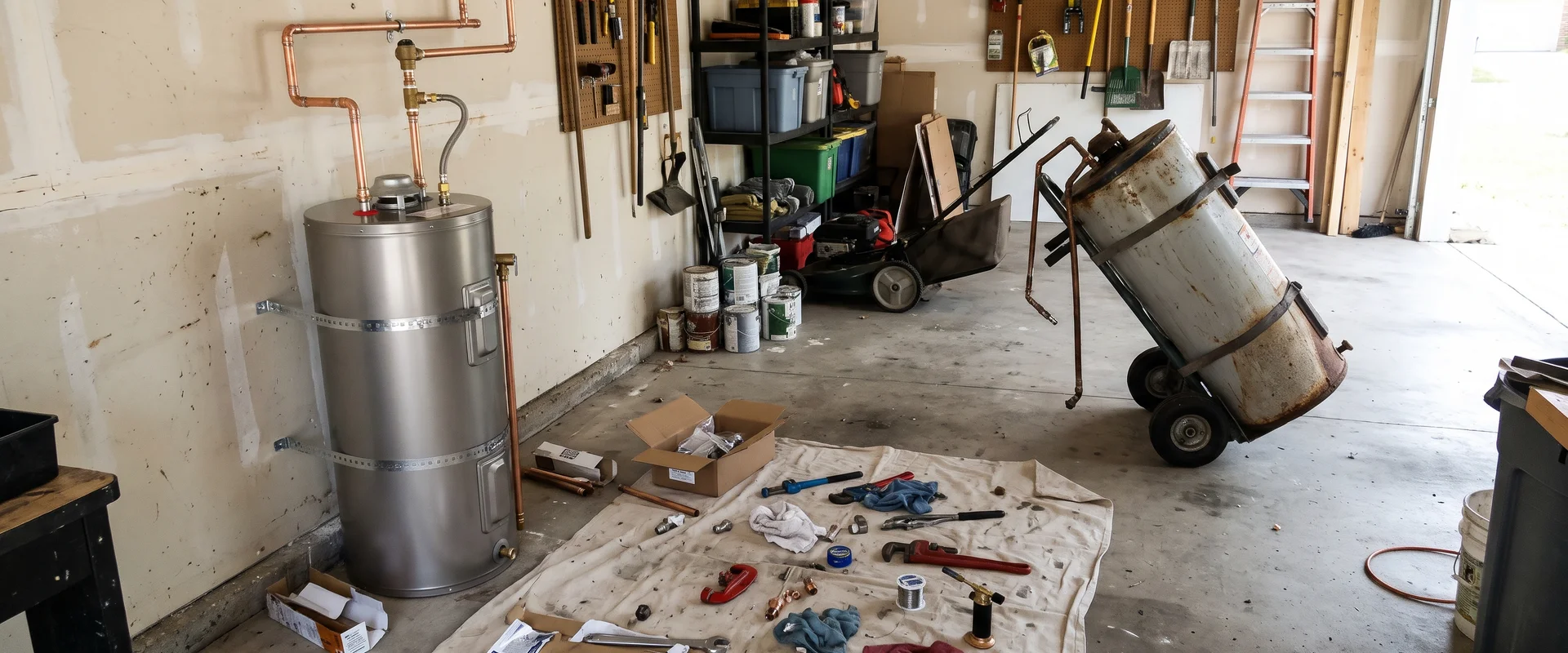
When replacement is the right call, sizing matters more than the brand. Capacity gets matched to how many showers run back to back, whether laundry and the dishwasher overlap, and how much recovery the heater needs on cold winter supply water.
- Permit check: Ask whether a permit is required for your replacement.
- Thermal expansion control: An expansion tank where the system is closed, so pressure has somewhere to go.
- Correct relief valve discharge: Piped to an approved location and protected from freezing.
- Venting and connections: Proper flue for gas units, new flex connectors, and secure strapping.
- Haul-away: The old unit leaves with the plumber.
After the install, a flushing and anode schedule helps the new heater last. Our water heater guides explain common failures in more detail.
Water heater service is available throughout Prescott, Prescott Valley, Chino Valley, Dewey-Humboldt, and Mayer. If a tank is leaking right now, shut off the cold supply and the gas or power, then call.