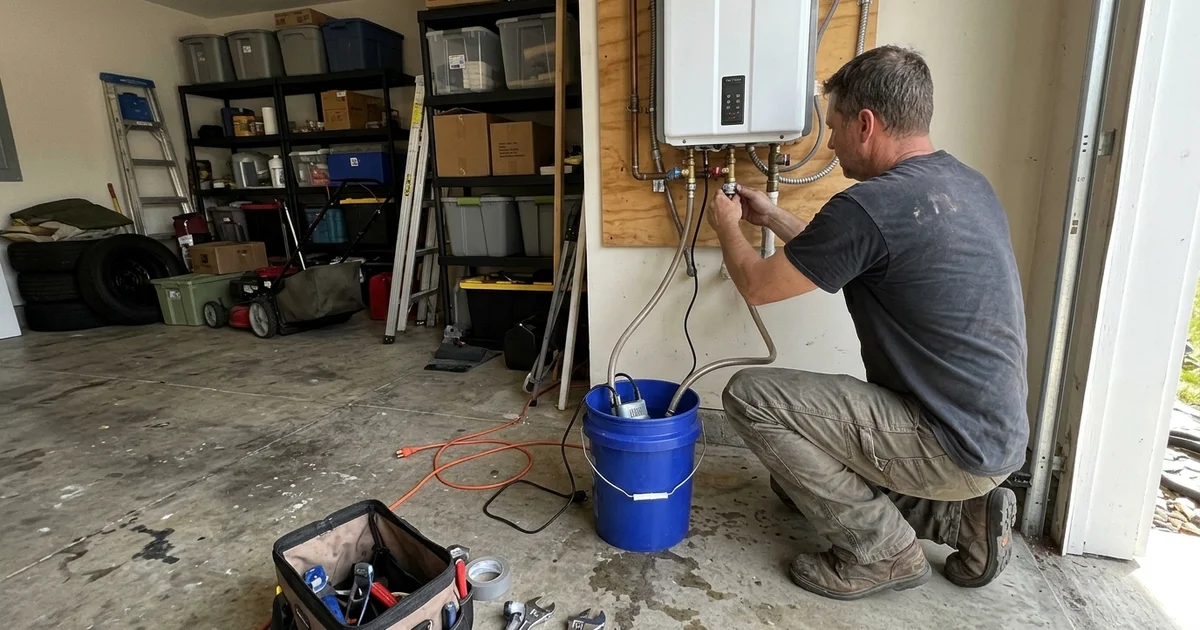
A tankless water heater promises hot water on demand and a long service life. Both depend on a clean heat exchanger. The good news for homes on Prescott city water is that moderately hard water scales a tankless unit slowly. The less good news is that “slowly” is not “never,” and many owners have gone years without the service their manual quietly recommends.
Why tankless units are sensitive to minerals
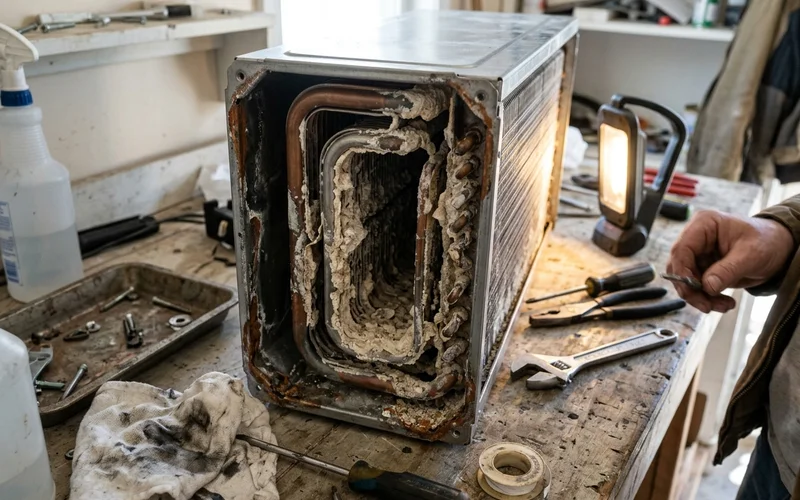
A tank heater warms a large volume of water gradually, and sediment falls to the bottom, mostly out of the way. A tankless unit forces water through narrow passages and heats it in seconds. That intense, fast heating is exactly what drives minerals out of solution, and in passages that tight, a thin layer has an outsized effect on flow and heat transfer.
What changes the interval here
Hardness. The City of Prescott describes its water as moderately hard, about 4.3 to 7.6 grains per gallon. That keeps buildup slow compared with very hard water regions.
Cold winter inlet water. In a Prescott winter, the water entering the unit is cold, so the burner fires harder and longer to reach the set temperature. More heat through the exchanger means a bit more scale per gallon than a mild-climate home would see.
Well water. Private wells can be harder than the city supply, and some carry iron or sediment that clogs the inlet screen. Test the water, and plan on inspecting sooner.
A starting schedule
| Your situation | Descaling interval |
|---|---|
| City water, 1 to 2 people, light use | Every 18 to 24 months |
| City water, 3 to 4 people | Every 12 to 18 months |
| City water, 5 or more people or heavy use | Every 12 months |
| Private well or other provider, untested | Every 12 months until the first inspection shows otherwise |
| Softener upstream, working properly | Every 24 months or longer, confirmed by inspection |
| Second home or cabin used part of the year | Every 24 months, ideally at the start of the season you use it most |
| Unit already showing a scale or flow code | Now, then restart the schedule |
If the unit has been running for several years and nobody has serviced it, assume it is due.
Local expert insight
Book descaling in the fall, before the cold months put the heaviest load on the unit. A clean heat exchanger handles cold incoming water much better than one already partly coated.
Warning signs, in the order they usually appear
- Output drops. The shower is not as hot at the same flow, especially on cold mornings.
- Temperature swings. Hot, then lukewarm, then hot again.
- Error codes. Many units flag scale buildup, overheating, or low flow, and some shut down to protect themselves. Check your manual.
- Heat exchanger damage. At this stage repair is expensive, and replacement often makes more sense.
The goal is to descale before you notice step one.
What happens during a descaling visit
- Shut down and isolate. Gas or power off, isolation valves closed.
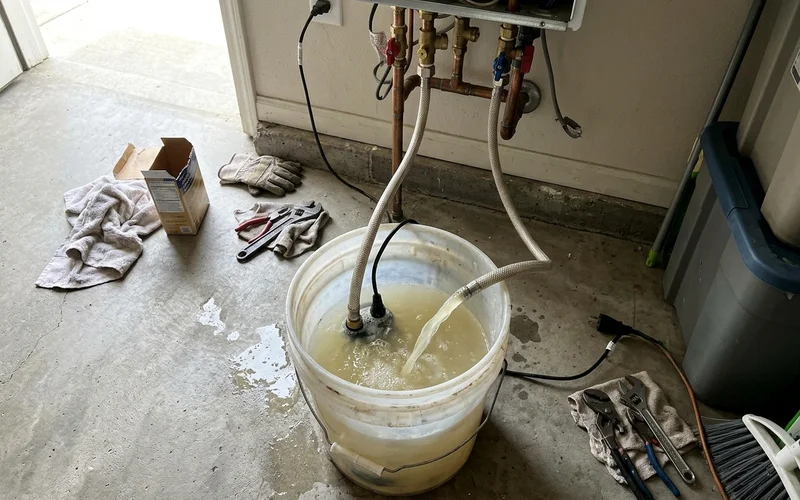
- Connect the pump. Hoses go onto the service ports and run to a bucket with a small circulating pump.
- Circulate descaler. Solution runs through the heat exchanger, often for about 45 minutes to an hour depending on buildup.
- Rinse. Fresh water flushes the solution out.
- Clean the inlet screen. The small filter on the cold inlet catches debris and is scrubbed.
- Restart and check. Valves reopened, unit fired, temperature and flow confirmed. On gas units at this elevation, it is also a good time to confirm the unit’s high-altitude settings match the manufacturer’s guidance.
Most visits take one to two hours. If the unit has no isolation valves, adding them comes first.
Does a softener change the schedule?
Yes, it stretches it. Softened water carries almost no hardness into the heat exchanger. On city water here, that is a nice-to-have rather than a necessity, but for a household with a tankless unit and heavy use, it is one of the stronger arguments for water softeners.
Descaling is part of our water heater service. Call Prescott Plumbing Pros at any hour, in English or Spanish. If the unit is showing a code, read it to the assistant so the plumber knows what to expect. Request a free estimate and ask about any service call fee before booking.