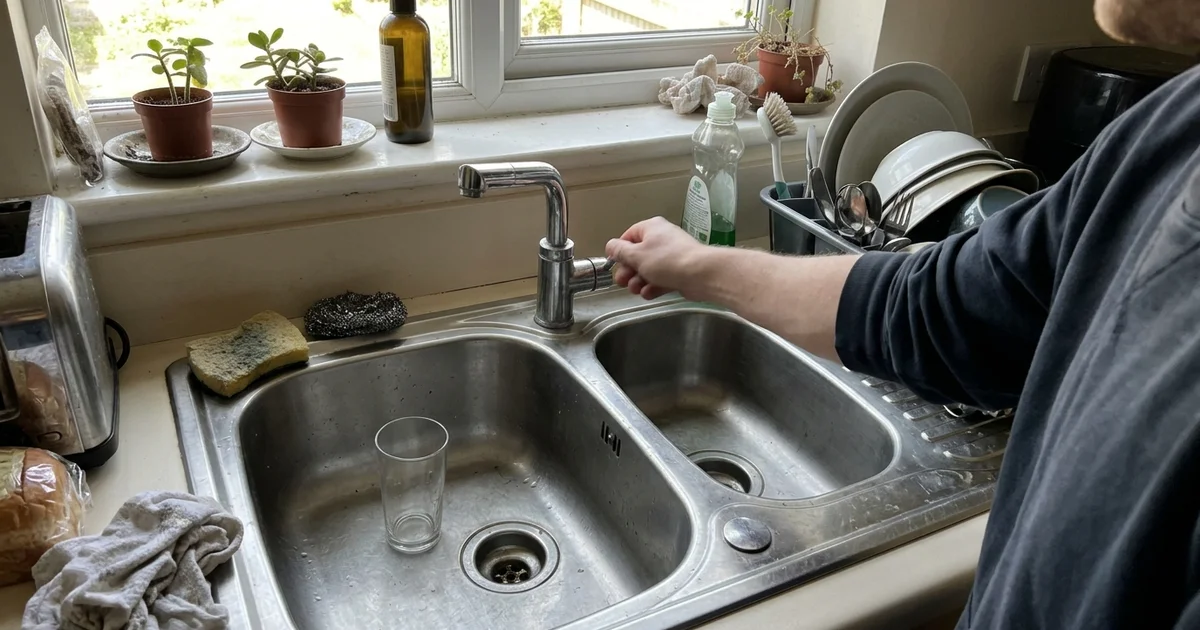
You turn on the tap and nothing comes out. The first worry is usually a burst pipe somewhere inside the walls, but a broken pipe usually gives you water where you do not want it. No water at all usually means something upstream is blocking the flow. In Prescott, on a cold morning, that something is very often ice.
What to expect, start to finish
| Stage | What happens | About how long |
|---|---|---|
| Your checks | Narrow it down with the checklist below | 5 minutes |
| The call | The assistant takes down six details | 3 to 5 minutes |
| The visit | A local plumber arrives knowing the likely cause | Depends on demand; cold snaps are busy |
| The fix | Thawing, a valve, a regulator, or a line repair | From under an hour to longer for a broken line |
The five-minute checklist
1. One fixture or the whole house? (1 minute) Try taps in two or three rooms, hot and cold. If only one is dry, the problem is that fixture’s supply line, its shutoff, or a frozen section in the wall behind it.
2. Did it freeze last night? (1 minute) After a hard overnight freeze, assume a frozen pipe until proven otherwise, especially if the dry fixtures are on an exterior wall or above a crawl space or garage. Keep the faucet open, keep the house warm, and warm the likely section gently. No open flame.
3. Do the neighbors have water? (1 minute) Ask next door or check your water provider’s notices. If the street is dry, it is a utility issue.
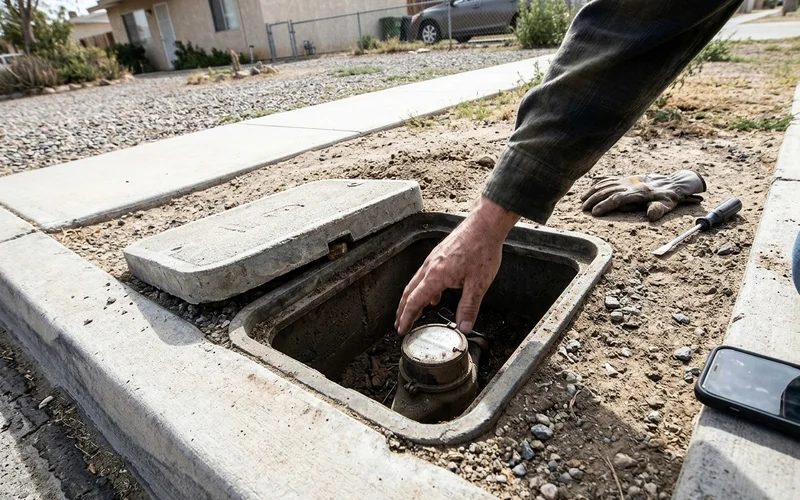
4. Are both valves open? (1 minute) Check the house main and the meter valve near the street. Someone who shut the house down months ago, or recent work on the property, may have left one closed.
5. Is the meter moving? (1 minute) With every tap closed, watch the low-flow indicator in the meter box. Spinning with nothing running means water is escaping between the meter and the house, likely a broken service line.
What it probably is
| What you found | Most likely cause | What happens next |
|---|---|---|
| Cold night, some or all taps dry | Frozen supply pipe | Thawing, then a check for splits |
| Whole street dry | Utility outage or main break | Wait for the provider |
| Valve was closed | Someone closed it | Open slowly and check for leaks |
| Valve handle spins freely, no flow | Gate dropped off the stem inside an old valve | Valve replacement |
| Pressure faded over a few days to nothing | Failed pressure regulator | Regulator replacement |
| Meter spinning, nothing running, wet patch in yard | Broken service line | Leak location and line repair |
| Pressure falling for years in an older home | Galvanized pipe corroded nearly shut | Repipe evaluation |
Pressure regulators
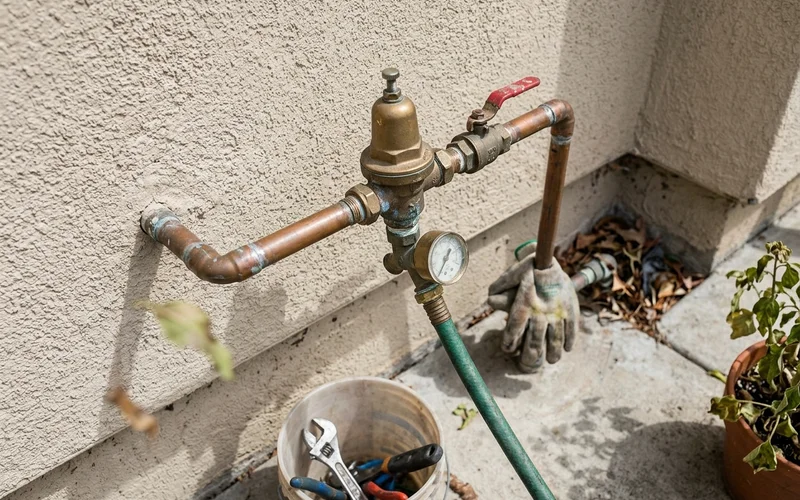
Many homes have a brass pressure regulator where the main enters. When its internal parts wear, pressure often fades over a few days before dropping to almost nothing. A regulator in an unheated space can also freeze.
Older galvanized pipe
In older central neighborhoods, galvanized supply pipe narrows from the inside over decades. That usually shows up as pressure falling slowly for years rather than a sudden stop. See repiping an older home.
Local expert insight
When a frozen pipe thaws, it may reveal a split. Once water comes back, stay nearby for the first hour, look under sinks and in the crawl space or garage, and know exactly where your main shutoff is.
Opening a cabin or second home
This scenario comes up every winter around Prescott. You arrive at a house that has been shut down and there is no water. Before anything else:
- Check that the main and the meter valve are both open.
- If the house was cold, assume a frozen section until the heat has been on a while.
- Leave the water heater off until water is flowing and the tank has refilled.
Once water returns, do a quick meter test anyway, because a freeze while the house was empty may have cracked a pipe.
What the assistant will ask
When you call Prescott Plumbing Pros, the automated assistant answers in English or Spanish and takes down whether it is the whole house or one fixture, whether neighbors have water, whether it froze overnight, whether both valves are open, whether the loss was sudden or gradual, and the rough age of the home and pipe material if you know it. Those answers reach a local plumber, who can arrive with thawing equipment, a valve, or a regulator instead of starting from scratch. For a house with no water, our emergency plumbing line is answered 24/7 at 928-555-0100. Ask about any service call fee when you book.