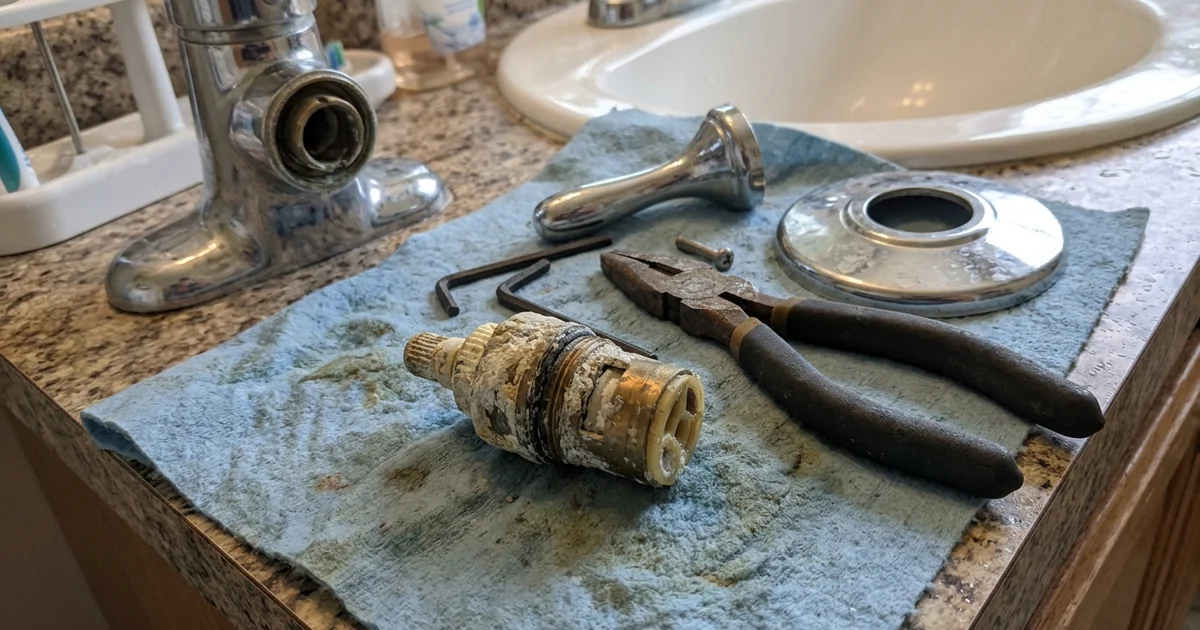
A dripping faucet is a small problem, but it is also a window into the rest of your plumbing. What wore out that cartridge, whether minerals, sediment, age, or a freeze, is often affecting other fixtures and valves in the house too. Here is what a cartridge actually is, why it fails, and how to decide between a rebuild and a new faucet.
What a faucet cartridge is
Most modern single-handle faucets control water with a cartridge: a replaceable valve with two polished ceramic discs inside. Turning the handle slides one disc across the other to open, close, and mix hot and cold. The seal depends on both surfaces staying perfectly smooth.
Older two-handle compression faucets work differently. They close by pressing a rubber washer against a brass valve seat. When the washer or the seat wears, the faucet drips no matter how hard you turn the handle.
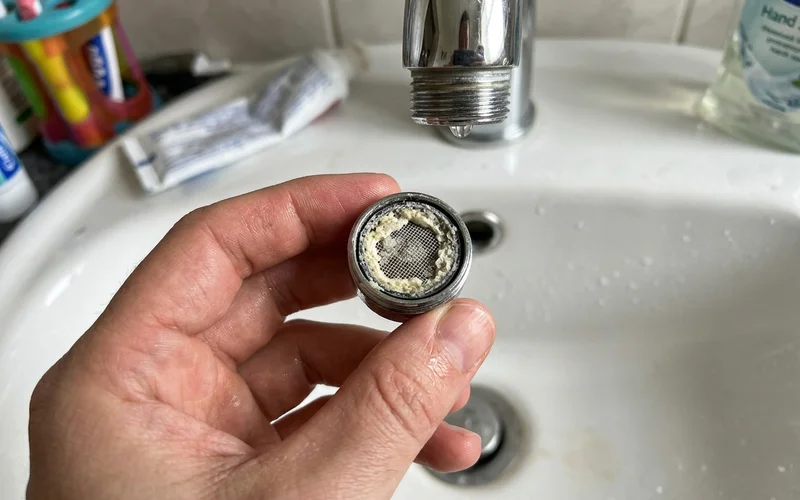
At the end of the spout, the aerator is a small screen that shapes the stream and catches debris.
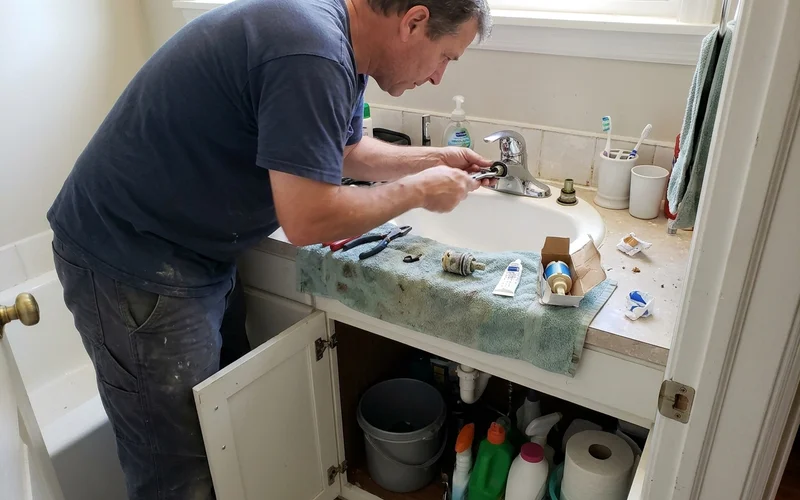
What wears them out in local homes
| Cause | How it does damage | Where it is most common |
|---|---|---|
| Sediment and rust | Particles get between the ceramic discs or under washers and score them | Older central Prescott homes with galvanized supply pipe; after any water main work |
| Minerals | A thin film builds on sealing surfaces and stiffens handles over time | Everywhere, but slowly on moderately hard city water |
| Freezing | Ice expands inside the valve and cracks it | Outdoor spigots, faucets on exterior walls, cabins that lose heat |
| Age and use | Seals and O-rings simply wear | Busy kitchen and bathroom faucets |
| Forcing a stiff handle | Snaps the stem or cracks the discs | Anywhere a handle already feels gritty |
The City of Prescott describes its water as moderately hard, so minerals are a slow, minor factor. In older homes, sediment from aging pipe is often the bigger one. On private wells, the picture depends on the water, so a test helps.
Local expert insight
If you keep replacing cartridges in an older home and the first draw of water is ever tinted, the faucet is not the real problem. Rust flaking from galvanized supply pipe is wearing out the parts. That points toward a pipe evaluation, not another cartridge.
Rebuild or replace?
| Condition | Rebuild | Replace |
|---|---|---|
| Body and finish look good | ✓ | |
| Parts available for the model | ✓ | |
| Only symptom is a drip or stiff handle | ✓ | |
| Body is corroded or cracked | ✓ | |
| Finish is pitting or flaking | ✓ | |
| Model discontinued, no parts | ✓ | |
| Already rebuilt two or more times | ✓ | |
| Cracked by a freeze | Usually ✓ |
A quality faucet body can outlast several cartridges. Replacing it just because that is faster than diagnosing the cartridge is not a good use of money. Our fixture repair and replacement work starts by figuring out which part actually failed.
The valves people forget
The small shutoffs under sinks and behind toilets sit in the same water and rarely get turned. In older homes they often seize. You find out when you try to close one during a leak and it will not budge, or it starts weeping at the stem. When a faucet is being serviced anyway, having those stops checked or replaced at the same time is sensible.
What slows the wear
- Clean aerators every few months. Unscrew, soak in white vinegar for about ten minutes, rinse, and reinstall. Do it right away after any water main work, when sediment tends to arrive.
- Do not force a stiff handle. Stiffness means something is already in the cartridge.
- Disconnect hoses before the first freeze. Close any inside shutoff for outdoor spigots and drain them.
- Exercise your shutoff valves once or twice a year so they do not seize.
- Consider treatment only if it fits. On Prescott city water, a softener is optional; it reduces mineral film but does nothing about rust from old pipes. Our water softeners page covers when it makes sense.
If several faucets are wearing out early, it is worth asking why. Call Prescott Plumbing Pros for a fixture repair estimate, in English or Spanish, any hour. Ask about any service call fee when you book.